Stop Violence against women and girls

Tuesday, 29 January 2013


V-Day is an organized response against violence toward women.
V-Day is a vision: We see a world where women live safely and freely.
V-Day is a demand: Rape, incest, battery, genital mutilation and sexual slavery must end now.
V-Day is a spirit: We believe women should spend their lives creating and thriving rather than surviving or recovering from terrible atrocities.
V-Day is a catalyst: By raising money and consciousness, it will unify and strengthen existing anti-violence efforts. Triggering far-reaching awareness, it will lay the groundwork for new educational, protective, and legislative endeavors throughout the world.
V-Day is a process: We will work as long as it takes. We will not stop until the violence stops.
V-Day is a day. We proclaim Valentine's Day as V-Day, to celebrate women and end the violence.
V-Day is a fierce, wild, unstoppable movement and community. 

11 Facts about Refugees

Monday, 28 January 2013


Consider how radically your world would change if, without notice, you were forced to leave your home and possessions behind and relocate to an area where you don’t know anyone and have no idea when you will eat next. This is the reality of millions of people across the world.
  1. A refugee is a person forced to leave his or her country because he or she is unable to live at home or because he or she fears harm. This can be due to fighting, religious or racial persecution, or natural disasters such as earthquakes and floods.
  2. An internally displaced person (IDP) is a person who has been forced to leave his or her home, often for the same reasons as a refugee; however, IDPs find another place to live within their own country. They usually live in makeshift camps where hundreds of other IDPs live because they have nowhere else to go.
  3. There are around 10.6 million refugees in the world, 1 million asylum seekers and 25.8 million internally displaced people (IDP).
  4. Most refugees and IDPs are in Asia and Africa, where about 9.2 million refugees and 18.1 million IDS are found.
  5. During flight from areas of conflict, families and children continue to be exposed to multiple physical dangers, such as sudden attacks, shelling, snipers and landmines. Often, they must walk for days with only limited quantities of water and food. Under such circumstances, children become acutely undernourished and prone to illness. They are often the first to die.
  6. Refugee/IDP camps are temporary shelters where 14 million refugees and up to 25 million IDPs live today. Sometimes people can end up living in one for well over a decade.
  7. Refugee camps often lack water, electricity, sanitation and health care. They are usually overcrowded and unhygienic. Children are especially at risk of malnutrition in refugee camps, and disease can spread very quickly.
  8. About 80% of internally displaced people are women and children. About half of the world’s refugees are children.
  9. Refugee and IDP children are more vulnerable to those forcing children to become child soldiers or to traffickers selling children as slaves. (There are already 5.7 million child slaves worldwide.)
  10. An estimated 300,000 underage child soldiers are currently serving in armies and militias around the world, some of them plucked straight from refugee camps. Untold numbers of older, but still vulnerable youths, have also been recruited.
  11. In times of war, the disintegration of families and communities leaves women and girls especially vulnerable to violence. Rape is a continual threat, as are other forms of gender-based violence, including prostitution, sexual humiliation and mutilation, trafficking and domestic abuse.


Tracy Chapman

Tuesday, 22 January 2013


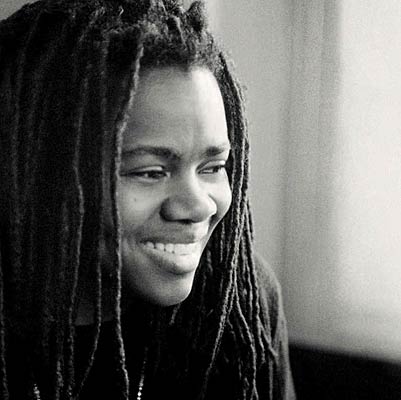
      Tracy Chapman is an American song writer born in 1964 in Ohio. She has been writing songs since she was eight, after her mother bought her a ukelele that waked her taste for music. Tracy attended the program “A Better Chance” and later she went to college and majored in Anthropology and African Studies.

        In 1978 Tracy joins an African drum ensemble at college, but in the meantime she develops her own guitar playing and performs self written acoustic songs. In 1988 she released her first album and the most commercially successful one. This namesake album was critically acclaimed and she began touring and building a fan base. “Fast Car”, “Talking About Revolution” and “Baby Can I Hold You” were her first hits and her most triumphant songs until our days. 

        I think that it is important to highlight that Tracy is not only an amazing musician but also a social activist. She has performed at numerous socially aware events, for instance she performed in London to commemorate the 40th anniversary of the Universal Declaration of Human Rights with Amnesty International. She also supported other causes like an Anti-Apartheid movement, an AIDS awareness event and the cause Make Poverty History. 

       Her will to make a better world can also be seen in her lyrics, for this reason I will attach her song “Subcity” that describes the life of the lower classes. I personally love her music and I think she is a great human being.  


“People say it doesn't exist
'Cause no one would like to admit
That there is a city underground
Where people live everyday
Off the waste and decay
Off the discards of their fellow man

Here in subcity life is hard
We can't receive any government relief
I'd like to please give Mr. President my honest regards
For disregarding me

They say there's too much crime in these city streets
My sentiments exactly
Government and big business hold the purse strings
When I worked I worked in the factories
I'm at the mercy of the world
I guess I'm lucky to be alive

They say we've fallen through the cracks
They say the system works
But we won't let it help
I guess they never stop to think
We might not just want handouts
But a way to make an honest living
Living this ain't living

What did I do deserve this
Had my trust in god
Worked everyday of my life
Thought I had some guarantees
That's what I thought
At least that's what I thought

Last night I had another restless sleep
Wondering what tomorrow might bring
Last night I dreamed
A cold blue light was shining down on me
I screamed myself awake
Thought I must be dying
Thought I must be dying”

Diana Barros


www.tracychapman.com/

About Precious:


Hello everyone, just passing by to share my thoughts on the movie we saw on the last English class.
I guess that this movie, Precious, gives us perspective. With this I mean that we spent our lives consumed in our own problems, especially at our age, without realizing how lucky we are sometimes. I don’t mean that we must be always happy and completely satisfied because that’s not humanly possible, but it is really important to value some parts of our lives, that we sometimes take for granted, like a safe home, a good education, a family who loves us, food on the table every day.
Of course this is a really strong and touching movie and I believe that it is not about this one girl but about many girls in the world with similar stories of tragedy and strength. But, although it is tragic, I don’t think that the movie was made to make us feel pity for the many “Precious” in the world, this is not a story of a “poor little girl”, this is a story of how a great and valuable human being broke through unthinkable pain and suffering, this is a message of hope. 

Greetings, Inês Ribas

Do not give up! Story of Gabrielle Andersen

Sunday, 20 January 2013


Gabrielle Andersen-Schiess was a marathon runner, born in Switzerland. In the Summer Olympics 1984, during the women's marathon, Gabrielle, completely dehydrated and was disoriented by the effort in the heat, in addition to having a strong cramp in her left leg, stumbled in the last 200 meters of the marathon taking 10 minutes to complete them, before falling unconscious in the arms of doctors at the finishing line. Refused medical assistance, resisted calls to give up and shuffled to the finish line after a whole round at the Olympic she wanted to finish the course because that might be her last chance in the Olympics due to be thirty-nine years. She just came in 37th place among 44 runners, but she was more applauded than gold medalist Joan Benoit.

The fact is considered to this day one of the greatest examples of perseverance, courage and Olympic spirit.
 It also served to change the rules. Thereafter it became possible for an athlete marathon to receive medical care without being disqualified, unless  carried or helped to move.
This is a way of saying that all our dreams can be accomplished, just fight, believe and work, and so everything will be alright.

https://www.youtube.com/watch?v=YZFNiuuApFU


Telma Soares 11º B

The Warsaw Anagrams by Richard Zimler

Thursday, 17 January 2013


This book is set in 1940-41 inside the Warsaw Ghetto itself. It is about the everyday frailties and courage of a varied cast of ordinary Jews. Erik, a distinguished elderly psychoanalyst, has to leave his comfortable flat and move into the Warsaw Ghetto, where the Jews were confined during the Nazi occupation of Poland. In the tiny flat of his niece, Stefa, and her nine year-old son Adam, he must not just adapt to a frozen, starving life on the edge of death, but learn to overcome his selfishness. It is the child Adam who sets the old man on this road.

The Warsaw Anagrams is a highly realist murder mystery.  One might wonder, why bother with one person's death, when slaughter is all around? "We owe uniqueness to our dead" is the imperative that Erik comes to understand. By remembering the uniqueness of each dead person, that person's humanity is maintained and the Nazis defeated in their desire to reduce the Jews to nameless ash.

Strawberry Fields Forever

Tuesday, 15 January 2013

This is a novel about a Portuguese adolescent who leaves Lisbon with her family to live in the suburbs of new York. Teresa can't speak proper english and she has problems to adapt to a new life and a new country finding refuge in her humour and in her best friend Angel ........Then her father dies and her problems are still bigger.............

A good read for sure.